

What is greenhouse gas acounting?
Green house gases are the atmospheric emissions that contribute to planetary warming. Basically, this is the underlying cause of climate change. Heat from the sun bounces off the earth and instead of dissipating back into space, these gases act like a blanket on the earth and the heat is reflected back.
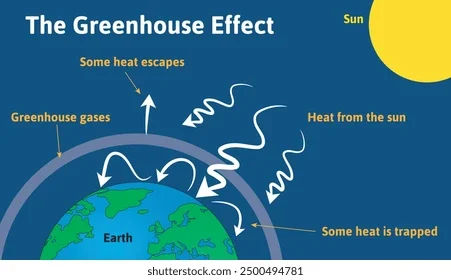
The greenhouse gas effect - image showing the blanket of greenhouse gasses that wrap around the earth reflecting trapped heat back to the earth.
Thre are a number of different gasses that make up this blanket - NASA has a nice little explainer here : (It's for kids, but that just means its fun)
Our best hope of slowing warming and maintaining a hospitable planet is to prevent further accumulation of green house gasses. This is often referred to as "Net Zero"- the total amount of emissions = the total carbon capture.
In other words, not making that atmospheric duvet cover any bigger. And that is where greenhouse gas accounting serves a critical role - we need to know how what we are doing is generating greenhouse gasses. If we can reconcile our gas emissions (whether corporate, country wide or personal) to our activities, we can change our activities and in so doing, change our collective future.
The steps to achieving net zero are theoretically simple
1. Determine current emissions based on activities
2. Determine alternative activities with reduced or elimiated emissions
3. Cost those alternatives
4. Divide potential emision reductions by cost of reduction
5. Rank alternatives
6. Begin to replace emission generating activities with zero emission alternatives.
Greenhouse gas accounting is the process of measuring an entity's net emissions. This can feel totally overwhelming at first - because there are emissions associated with everything from shipping to heating to waste disposal - even cow farts! However, if we agree that the goal is net zero, the first step is knowing where our emissions are coming from.
The reason this is a job for accountants is that we are measurement professionals.
In order for this information to be useful, it needs to have many of the same characteristics of financial accounting information, namely:
Relevance - It needs to enable people to make better decisions
Completeness - It needs to report on all sources
Consistency - We need to be able to compare one entity to another and one entity to itself in a different time
Transparency- The data needs to be easy to understand to an outside source
Accuracy - We need the information to be accurate
We achieve this by collectively agreeing on the rules which is what The Greenhouse Gas Protocol aims to do.
Climate change is not just a disaster- it is an opportunity. I believe we can change this future together and I believe that understanding and planning around greenhouse gasses is a critical step.